QIRSH. Product decisions behind every payment step.

A business development project exploring an Arabic-first pay-and-receive wallet, from concept and operating model to a user experience and testable technical components.

My role
Business Development and Product Direction
Documented milestone
Product development — October 2026
Status
In development — isolated demonstration
قرش · QIRSH
قرشQIRSH

One experience for paying and receiving.

Decisions began with the user’s needs and what it would take to operate the product, then became a user journey and requirements that can be implemented and checked.

The product opportunity

The hypothesis: simplify digital-asset payments around two clear actions, Pay and Receive, with personal and small-business accounts under one identity and no need for the user to manage ETH for each operation. This remains a hypothesis under test; independent market research, customer numbers and revenue do not yet establish adoption.

My role: defining and directing the product

I led the concept, user experience and operating model: Arabic first, a unified pay-and-receive flow, separate personal and business-use accounts, and administrator-funded network fees. I also directed recovery and governance choices, identity, motion and sound reviews, and follow-up on tests and device checks, supported by AI-assisted implementation and review.

The product and operating model

The scope includes child accounts, beneficiaries, account groups, split payments and recurring transfers that require fresh approval when due. The model proposes a capped QIRSH usage fee and administrator-funded ETH costs. These decisions became a bilingual journey, original identity, investor pitch, interactive prototype, Android components, contracts and an SDK; they are not yet proven as a revenue-generating business.

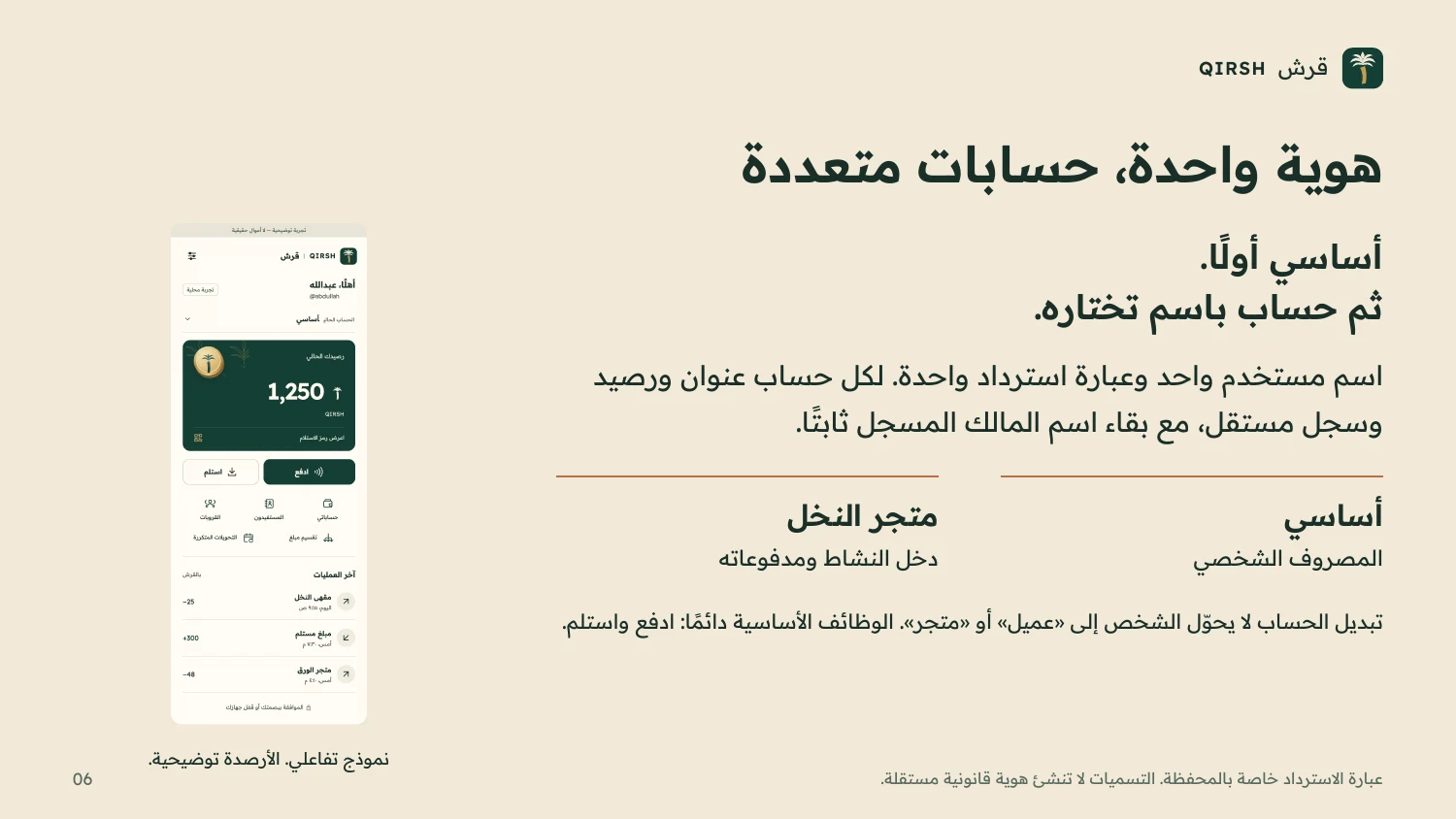
Two ways to use the same wallet

Explore the product layers.

Select a layer to understand its responsibility, its relationship to the experience and its evidence limits.

This architecture describes the source product. The downloadable demo is an isolated experience with a different scope, explained in the demo section.

From request to receipt.

Follow the payment journey step by step. This explains the product’s states and decisions; it does not submit a transaction.

This is the source product flow and its new local components; complete integration with the visible V5 controllers is unfinished. This walkthrough explains the states only.

  1. Receive request

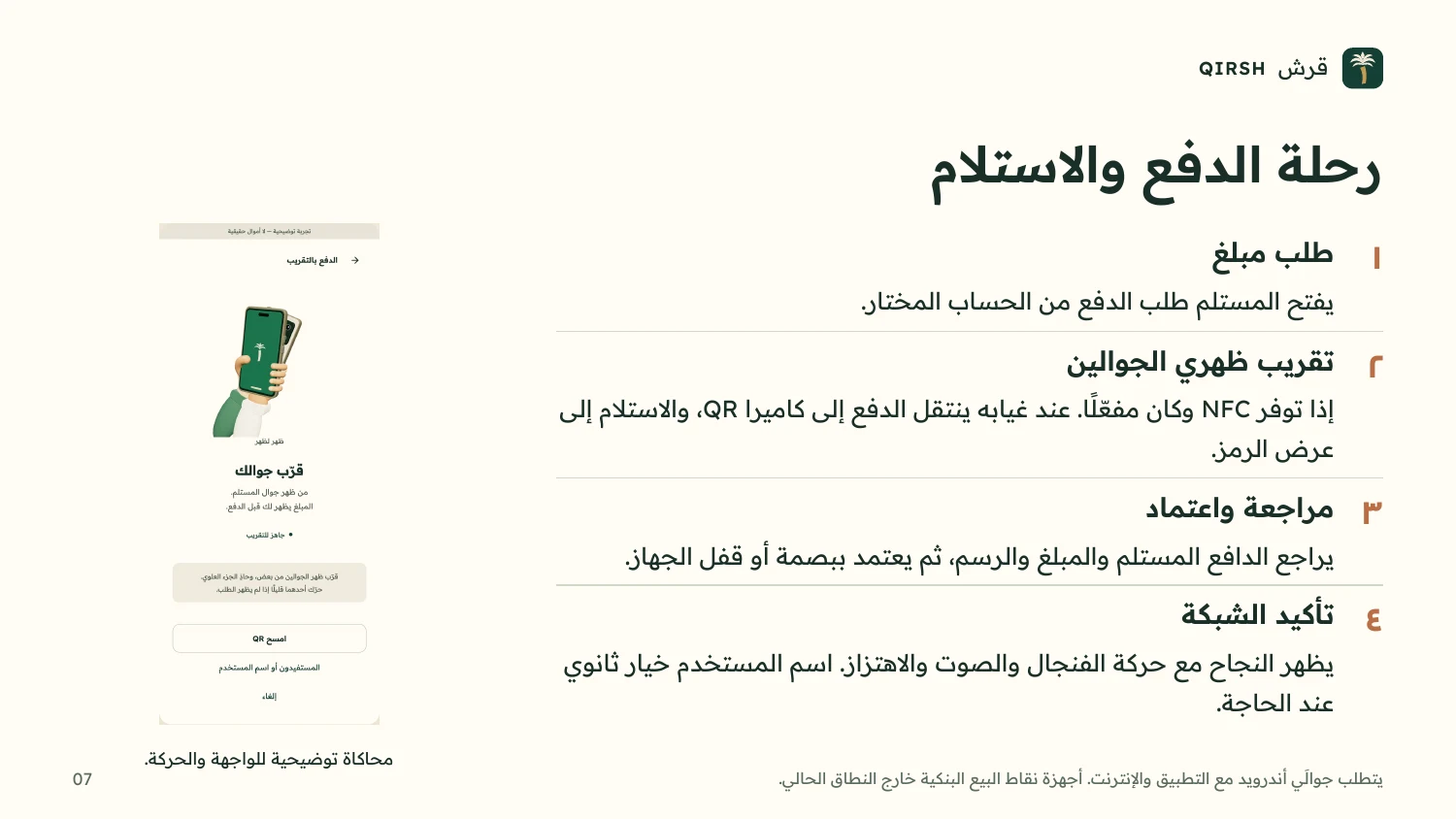
    The recipient selects an account and amount, then shares a request that the payer accesses through an available product channel.

    Request available for review · Request information is available. Settlement has not started.

  2. Review details

    The payer reviews recipient, account, amount, fees and total before deciding to submit.

    Awaiting the user’s decision · Clear transaction details represent review, not a payment receipt.

  3. Explicit approval

    Required approvals are completed, then the payer authorizes the operation through the device prompt. The path journals signing state before key access and exact signed bytes before submission.

    Approval for this operation · Authorization permits the flow to continue; the result comes from execution and confirmation.

  4. Submit and wait

    The operation enters the sponsored execution path. Provider acceptance remains pending; a timeout does not permit a new submission without resolving the previous operation’s state.

    Pending confirmation · Submission alone does not establish receipt of payment.

  5. Confirmed receipt

    An independent path checks the operation, events, nonce consumption and canonical-chain finality. Only then are the receipt and success feedback tied to the appropriate confirmation.

    Confirmation backed by execution evidence · This explains the source product flow. The demo simulates these states using illustrative data.

Decisions that shape the product.

Each decision affects the experience, operating costs and what needs to be validated.

Decisions that shape the product.
DecisionReasonTrade-off
One interface for individuals and small businessesKeep pay and receive understandable while organizing accounts by use.A named account does not change its holder’s identity or verify a business entity.
NFC with clear alternativesReduce steps to a payment request when NFC is available, with QR and username alternatives.Different device capabilities require fallback paths and physical-device testing.
Explicit approval before submissionTie the decision to a clear recipient, amount and fee.Approval adds a deliberate step and requires correct cancellation and continuation handling.
Network-fee sponsorshipRemove the need for users to manage ETH in the intended payment experience.Funding and availability responsibilities move to the operating model and sponsor.
Separate private dataReduce exposure of receipt details and private information on the public record.Access permissions, storage and independent review still need to be defined and validated.
Custom Arabic recoveryOne root restores primary and child accounts under the selected language constraints.QIRSH-AR1 is custom; it requires explicit support and does not assume BIP39 compatibility.
Explicit issuance, burn and upgrade authorityAllow administration of issuance rules, operations and future changes.Centralized issuer authority remains; upgrade scheduling does not remove that dependency.

Where does the project stand?

This case-study material was prepared on 1 November 2026. The latest recorded combined source build is dated 13 October 2026; the evidence below retains its date and scope and is not a fresh network verification.

Documented in development

  • Original identity and an Arabic/English interactive prototype with accounts, simulated payment states, motion and sound.
  • Source and Android wallet/admin apps, V5 contracts, an SDK, and recovery, signing and private-journal components.
  • 1,466 local tests across 139 suites in the 13 October 2026 build; a build result, not a completion percentage or proof of public payments.
  • Separate historical evidence verifies the initial V5 contract deployment on Base and its finality on 13 October 2026.

Separate acceptance requirements

  • Connect the visible controllers to V5 and complete end-to-end registration, account linking and batch splits.
  • Activate the public gas stack: funding, policy, production provider and operating balances.
  • Complete private-record finality and recovery, real device authentication, two-direction proximity and two-phone acceptance.
  • Appropriate privacy, security and regulatory reviews before any public financial availability.

This portfolio does not claim a public launch, real customer payments or independent security certification.

General technical references

These sources explain the underlying technologies; they do not establish their implementation or results within QIRSH.

Try the test wallet.

A standalone interactive QIRSH experience using synthetic data, with no real funds or transactions. It demonstrates the journey; it does not run the original connected wallet or administrator powers.

QIRSH

A standalone demonstration

Explore payment, review and receipt flows using illustrative data. Each version’s scope explains what it actually supports.

  1. Open the demo and choose Pay. Use the Demo tools below the wallet to simulate proximity.
  2. Review the amount, then confirm and simulate device approval and network confirmation; all are illustrative states.
  3. Explore child accounts, groups and splits. Reloading the page resets the demo state.
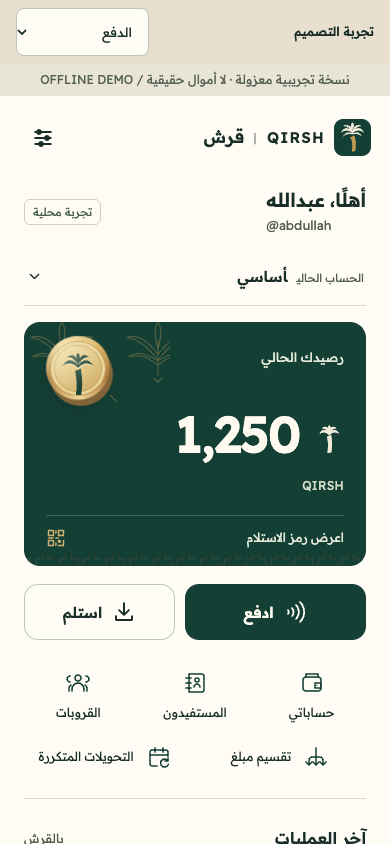
The Arabic QIRSH prototype with an illustrative balance and synthetic dataافتح الصورة الأصليةOpen the original image

من داخل النموذج.Inside the prototype.

Isolated browser prototype · Synthetic data

Explore the wallet demo

Let’s discuss the next product.

For a project connecting business opportunity to a clear experience and delivery plan, or a role in business development and digital marketing.