
Suqya
- My role
- Business and Donor Journey Concept Development
A side-project concept for the donor journey, channels and proposed procedures; it has not been implemented as an operating service.
Choose document · 4
Browsing the complete project archive. Entry for Suqya · p.
The work in detail
- In the proposed delivery workflow, a courier would receive the refill order, stock the box and photograph its interior. I proposed sending that photo back to the system to close the order and notify the donor.Pitch_Delivery_Apps · p. 2
- I designed an optional gift path. If the donor chose it, the recipient would also get the refill photo by text or WhatsApp and could choose to pass on a donation.Donor journey and outreach
- The project file includes an identity guide, donor journey, operating and risk papers, three partnership proposals and six letters drafted for prospective stakeholders.
Project documents and data
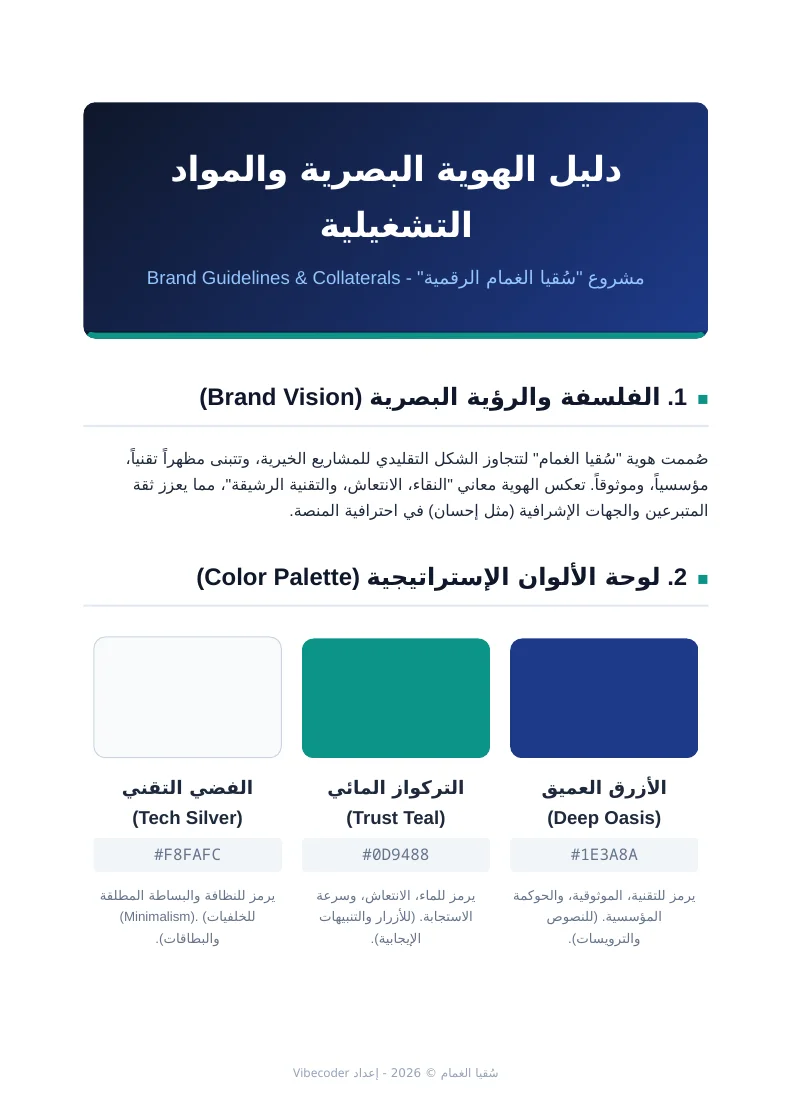
From the Suqya identity guide
Concept notes
Brand and field materials
How would a worker recognize a refill point and know what to do there? The guide starts with that moment and then considers what the donor and operator would see.
- The guide specifies deep blue (#1E3A8A) for headings, teal (#0D9488) for interaction and pale silver (#F8FAFC) for backgrounds. It pairs Tajawal for Arabic with Inter for English and numbers.
- Donor copy focuses on fulfillment and gifting. Institutional copy emphasizes governance and data. Worker instructions use water and ice symbols with short translated text.
- Proposed applications include an insulated box, a weather-resistant QR sticker, paper cups with a feedback or maintenance link, and a task notification inside a delivery app.
Donor journey and acquisition
The donor selects a box that needs a refill. After funding it, the donor could dedicate it to someone and receive a fulfillment photo once the task is complete.
- The recipient would receive a link explaining the refill and offering another opportunity to give. The paper treats that loop as an acquisition hypothesis.
- The paper compares delivery-app notifications during hot hours, region-specific content and advertising, fulfillment messages and seasonal reminders. A conversational enquiry could show current demand.
- The pilot tracks donor acquisition cost, repeat giving during the month and referrals through gifting.
Operating procedures
The operating paper connects five workflows so a team could follow a need from the worksite through fulfillment.
- Site setup. Select a service point, prepare its insulated box and connect it to a digital record and QR code.
- Demand. A worker selects water, ice or cups. The proposed system checks the request against the service location.
- Funding and dispatch. A donor chooses a need, then the funded request becomes a task for the logistics provider.
- Fulfillment. The courier collects supplies, refills the box and documents completion with a photo for the donor.
- Quality. The operating team reviews fulfillment evidence, routes faults to maintenance and follows up on delays with the provider.
Protection and risk management
The paper addresses supplies, request validity, proof of completion and financial oversight. This reading edition presents its operating principles.
- In the field, the design proposes a dispenser suited to drinking on site, with controlled refill access and checks on box condition.
- Digitally, each request is associated with a service location. Duplicate demand is managed so a single refill does not create parallel tasks.
- Operationally, tasks go to a provider able to track couriers, and closure depends on fresh fulfillment evidence.
- Financially, the proposal places funds under the oversight of an appropriate nonprofit or giving channel and makes the cost of technology operations visible.
Delivery partnership proposal
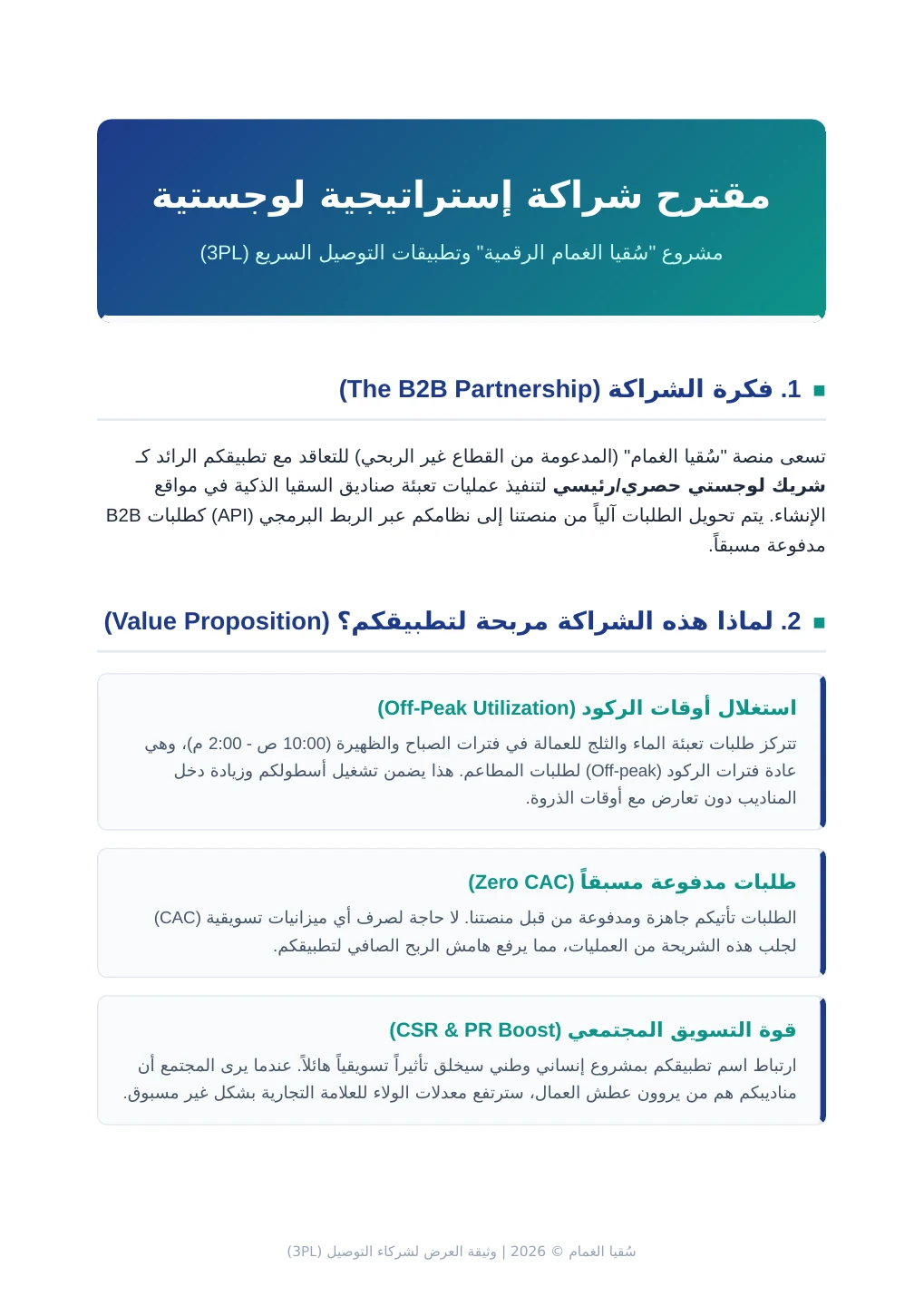
The pitch addresses delivery apps as potential providers for standardized, prepaid refill tasks.
- The proposed commercial value is use of couriers during quieter restaurant-order periods. The platform would supply tasks for the provider’s fleet to fulfill.
- An integration would send the site and supply requirements to the provider. After the refill, fulfillment evidence would return to the platform to close the request and notify the donor.
- Discussion points include response time, initial coverage in Riyadh, Jeddah and Dammam, and pricing that combines supplies and delivery.
Municipal partnership proposal
The proposal considers how construction-site data might inform box placement and how the city might track results.
- The design connects standardized service points, cleaner surroundings and access to water and ice. Contractors could be invited to sponsor boxes at their sites.
- With the municipality’s permission, permit data could inform a construction-density map and help prioritize locations by need.
- A proposed dashboard shows active locations, geographic distribution, beneficiaries and waste indicators. A pilot would require coordination on permissions, data and local support.
National nonprofit integration proposal
The pitch distinguishes technology operations from donation oversight and proposes review with the National Center for the Non-Profit Sector and Ehsan.
- An eligible organization would oversee donations while Suqya managed demand, dispatch and evidence. The proposed flow would display operating costs to the donor.
- The proposal suggests seasonal refill opportunities and reporting on locations, distribution and beneficiaries for the supervising organization.
- Expansion would depend on operating nonprofits and delivery coverage in each region. Agreements with those parties are prerequisites for future implementation.
Draft letter to a delivery app
The letter is intended to open a commercial and technical discussion with a prospective delivery provider.
- It explains how prepaid refill tasks could use fleet capacity in the morning and at midday, with an opportunity to demonstrate community involvement.
- The requested next step is a meeting with the partnerships team to discuss integration, photo confirmation, service levels and pricing.
Draft letter to Ehsan
The letter proposes Suqya as a possible technology and logistics operator for seasonal giving opportunities.
- A refill opportunity would appear through the giving channel, a participating nonprofit would oversee the funds, and Suqya would coordinate delivery.
- It asks the product and projects team to discuss exchanging fulfillment reports, showing donors what was completed and exploring a multi-region model.
Draft letter to a local nonprofit
The letter invites a nonprofit to discuss a geographically bounded pilot.
- The nonprofit would provide local oversight, with delivery supplied by an external provider rather than investment in another fleet.
- The draft explains how gifting and refill photos could support donor communication and asks the executive team to review the proposed dashboard.
Draft letter to a municipality
The letter focuses on service locations, their surroundings and workers’ daytime need for water.
- It proposes limited coordination to understand construction density, choose box locations and measure water distribution and potentially avoidable waste.
- The closing request is a meeting with community-responsibility and digital-transformation teams to assess a field pilot.
Draft letter to the National Center for the Non-Profit Sector
The draft requests regulatory review of the proposed operating and funding model before a pilot.
- It distinguishes the organization overseeing donations from the technology operator and asks for review of how hosting, messaging and maintenance would be funded.
- The draft connects governance to reviewable fulfillment evidence and requests a technical and operational meeting to discuss suitability.
Draft letter to the Council of NGOs
The letter proposes a common model that several nonprofits could operate locally.
- The nonprofits would share a platform and use delivery providers, while each organization would retain oversight of its own service locations.
- It requests a dashboard demonstration for the council and discussion of a multi-city pilot and consistent impact reporting across participating organizations.